

Geometry Vibes Monster gameplay video
Watch a full run to see how the monster attack patterns work before you dive in.
What's Geometry Vibes Monster game?
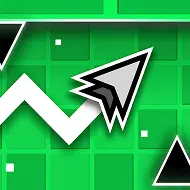
Geometry Vibes Monster drops your spaceship into a colorful obstacle course where the track, the rhythm, and eight different monsters all want to end your run. The base challenge is familiar: hold or tap to ascend, release to fall, and weave through spikes and walls while the course accelerates. What sets this game apart is the monster layer. Partway through a run one of eight creatures enters the field, each carrying a distinct attack pattern that forces a real shift in how you read and time your inputs.
Endless Mode and Race Mode sit alongside each other. Endless is the solo record chase: survive as long as possible while the pace climbs and monsters rotate. Race Mode brings up to four players onto the same screen, each controlling their own ship, with the last one standing taking the match. Both modes run in a browser with no download, so the barrier to a quick game or a group session is zero.
Hold to rise, release to fall
The spaceship moves forward on its own. Your only control is vertical: hold MOUSE or SPACEBAR to climb, release to drop. Timing between those two states is where every collision or clean gap lives. Spikes sit above and below the flight corridor, walls appear without warning, and the margins shrink as speed increases.
Controls for every player count
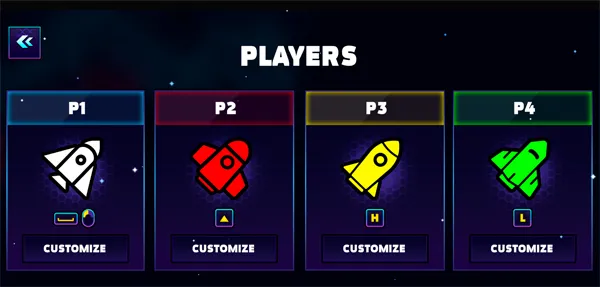
Solo play uses MOUSE or SPACEBAR to ascend. In multiplayer, each player gets their own key so everyone can race on the same device without stepping on each other:
- 2 players — Player 1: MOUSE or SPACEBAR Player 2: ↑
- 3 players — Player 1: MOUSE or SPACEBAR Player 2: ↑ Player 3: H
- 4 players — Player 1: MOUSE or SPACEBAR Player 2: ↑ Player 3: H Player 4: L
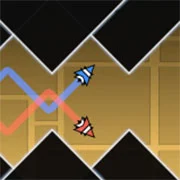
Because all ships run through the same course simultaneously, crashing does not pull you out of the race. The last ship still flying takes the round.
Eight monsters, eight different problems
Each monster introduces a specific threat on top of the static obstacle course. Some fire laser beams that track your current height and punish hovering in one position too long. Others spray patterns that require you to commit to a level and hold it, rather than constantly adjusting. A few slow the apparent reading time by flooding the screen with visual noise.
The key to handling them is recognizing the attack cycle early. Most monsters telegraph their move one or two seconds before impact. Once you identify which creature is active and recall its rhythm, the danger becomes a pattern to solve rather than a random threat. That recognition process is the real skill curve in this game.
Endless Mode: personal distance records
In Endless Mode the only goal is to stay alive. Distance is the score. Early sections give you room to read the obstacles and calibrate your hold timing. Around the midpoint monsters begin appearing more frequently and the safe windows between attacks narrow. Getting a genuinely high distance score requires handling the obstacle geometry and monster patterns at the same time, which is harder than either element alone.
Restarts are immediate. There is no loading screen between attempts, which keeps the loop tight: crash, assess what went wrong, try a different timing on the next run.
Race Mode: local multiplayer on one screen
Race Mode works best with two to four people sharing a keyboard or a single device. Ships launch together, the course is identical for everyone, and whoever survives the longest wins. Because losing a player does not pause the game, watchers can call out monster patterns to the remaining ships, which turns the mode into a light spectator moment as numbers dwindle.
It is not a ranked online system. The appeal is immediate: sit next to someone, pick race mode, and see who panics first when the second monster appears.
Visual rhythm and audio design
Bright colors and music that moves at the same pace as the obstacle density are not decoration here. They function as timing guides. When the beat accelerates, the course gets busier; when a monster attack is about to start, the audio usually shifts before the visual cue arrives. Playing with sound on gives you slightly more reaction time than playing muted.
Playing on mobile
Touch controls replace hold and release with a tap anywhere on screen. Single finger play works well for solo runs. Multiplayer on mobile is tight but possible on a tablet, where each player claims a side of the screen for their tap zone.
Related picks on spacewaves2.net
If the vertical dodge and obstacle rhythm appeal to you, these titles cover similar ground from different angles:
- Arrow Wave for platform style wave stages with arrow shaped ships and 24 levels of increasing density.
- Wave Dash for a procedural tunnel runner where the layout reshuffles every restart.
- Shape Rush for a six level rhythm platformer where portals shift your form mid run.
- Wave Games and Geometry Games for every browser arcade page on the site.
How to Play Geometry Vibes Monster
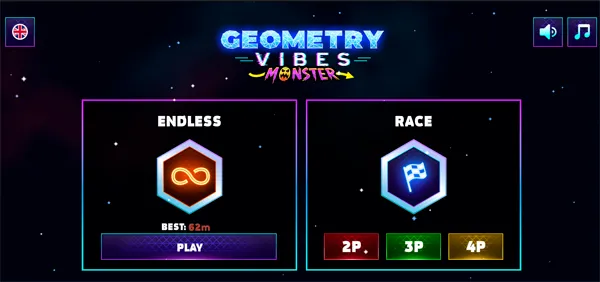
Open the game and learn the basic hold mechanic
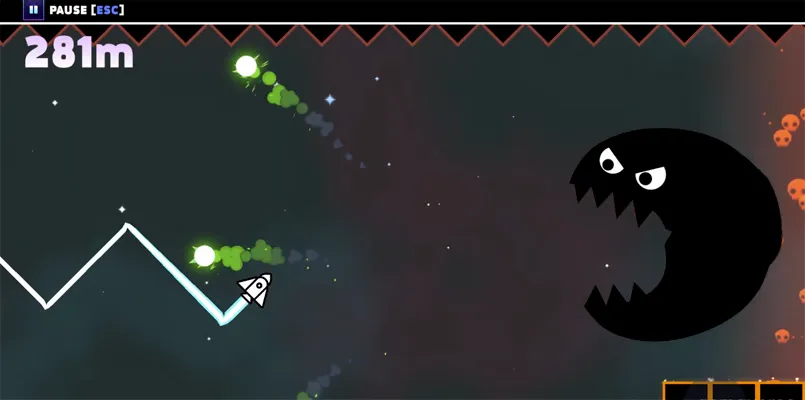
Watch for monster attack patterns
When a monster appears, pause your instinct to react immediately. Give yourself one second to spot which creature it is and recall its attack cycle. Most patterns repeat on a fixed rhythm, so identifying the beat early lets you plan your position rather than reacting blind.